
Skinny-Fat at 35: Why Eating Less Is Keeping Your Body Soft
5 min read · Dubai-specific · 3-step recomposition protocol inside
You are not overweight. Your BMI is technically normal. But when you look in the mirror — or feel the softness around your midsection despite years of watching what you eat — something feels fundamentally wrong. Welcome to the skinny-fat paradox: a body composition problem that affects a significant proportion of Dubai's professional population, and one that conventional dieting makes dramatically worse.
The skinny-fat condition — clinically referred to as normal-weight obesity or sarcopenic obesity — is defined by a simultaneous excess of body fat and a deficit of lean muscle mass. It is not a cosmetic inconvenience. It is a metabolic state that increases your risk of insulin resistance, cardiovascular disease, and chronic fatigue, regardless of what the scale reads.
Why Do You Look Skinny-Fat? [The Hidden Body Composition Problem]
The skinny-fat body type emerges from a specific combination of factors that are remarkably common among Dubai's high-performing professional class: long sedentary working hours in air-conditioned offices, high chronic stress from demanding careers, disrupted sleep patterns from late-night socialising or screen time, and a history of calorie-restrictive dieting without structured resistance training.
The result is a body that has, over time, lost muscle mass while retaining or accumulating fat — particularly visceral fat around the abdomen. The scale may show a "healthy" number, but your body fat percentage tells a very different story.
Why Eating Less Makes Skinny-Fat Worse [The Sarcopenic Trap]
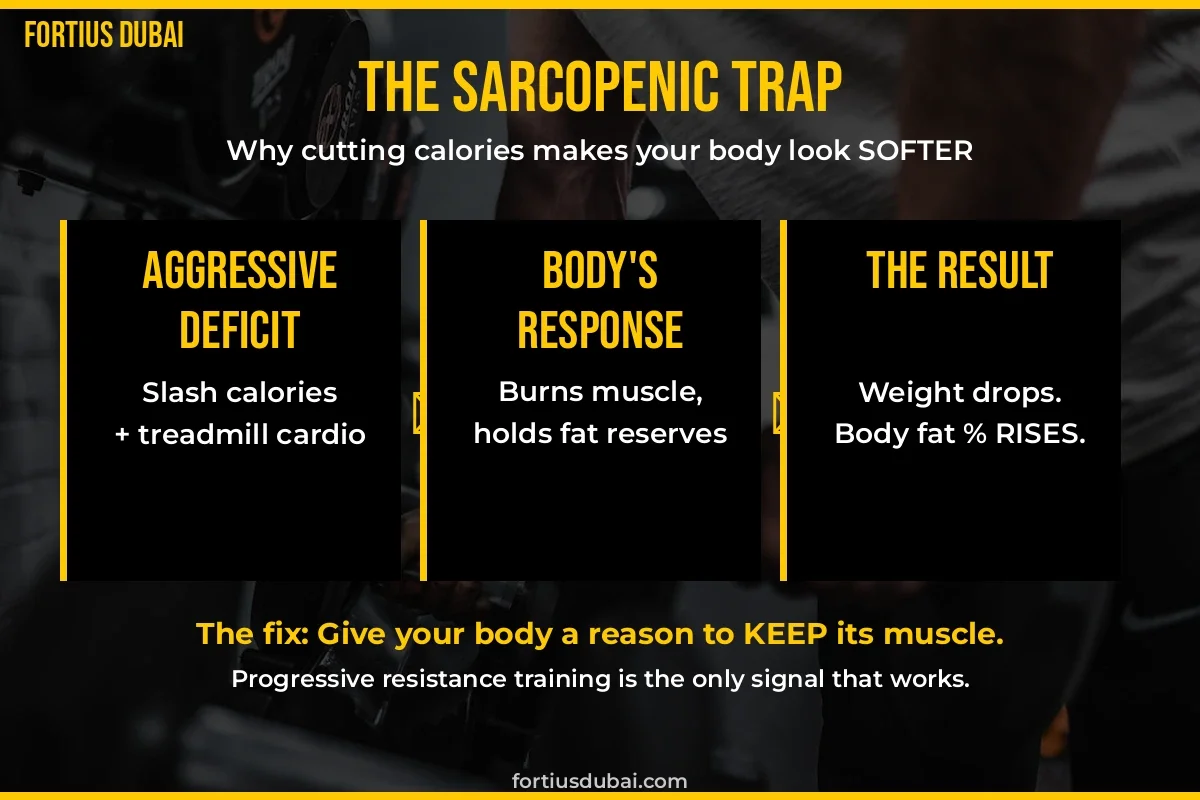
This is the central paradox that most people never understand. When you aggressively cut calories without providing your body with a reason to preserve muscle — specifically, the mechanical tension signal from resistance training — your body does not preferentially burn fat. It burns whatever is most metabolically expensive to maintain. Muscle tissue is expensive. Fat tissue is not.
The result is a process called sarcopenic dieting: you lose weight, but a disproportionate amount of that weight is lean muscle mass. Your body fat percentage actually rises even as the scale drops. You end up lighter, but softer — and with a slower metabolism than when you started.
The fix is not eating less. It is giving your body a reason to keep its muscle.
The Cortisol-Thyroid Connection [Why Meal Skipping Drives Belly Fat Storage]
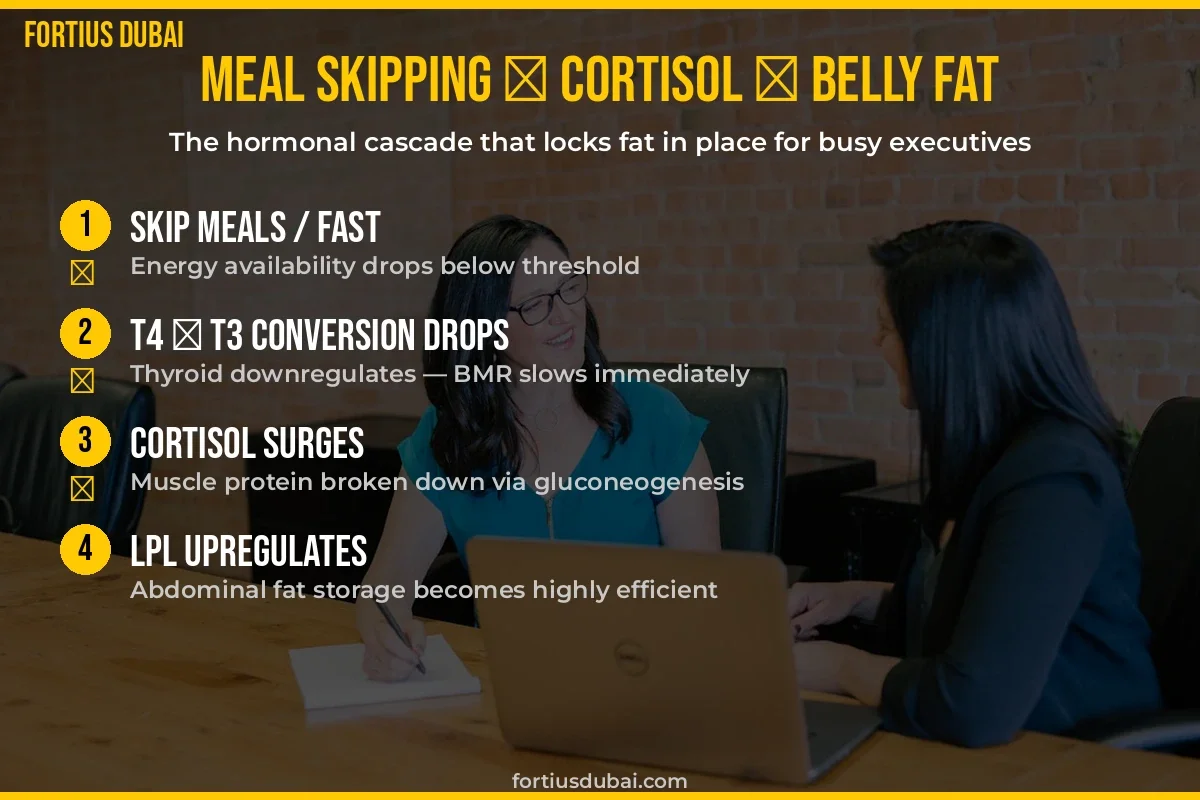
There is a second hormonal mechanism at work that is particularly relevant for Dubai's executive population: the cortisol-thyroid cascade triggered by meal skipping and chronic under-eating.
When caloric availability drops below a threshold — typically around 1,200 calories per day, or when meals are skipped for extended periods — the body interprets this as a famine signal. The thyroid reduces its conversion of T4 to active T3, slowing your basal metabolic rate. Simultaneously, cortisol surges to mobilise energy through gluconeogenesis, breaking down muscle protein for glucose. The downstream effect of chronically elevated cortisol is a significant upregulation of lipoprotein lipase (LPL) activity in abdominal adipose tissue — meaning your body becomes extraordinarily efficient at storing fat around your midsection.
This is why the executive who skips breakfast, eats a small lunch at their desk, and then overeats at a late dinner continues to accumulate abdominal fat despite consuming relatively few calories overall. The timing, the hormonal environment, and the absence of resistance training create the perfect conditions for fat storage and muscle loss to occur simultaneously.
How to Fix Hormonal Recovery [Reversing the Cortisol-Thyroid Downregulation]
Reversing the cortisol-thyroid cascade requires three targeted interventions. First, selenium and zinc intake must be adequate — both are essential cofactors for T4-to-T3 conversion. Brazil nuts (2 per day), pumpkin seeds, and lean red meat are the most efficient dietary sources available in Dubai. Second, meal frequency matters: distributing protein intake across 3–4 meals per day maintains a positive nitrogen balance and prevents the cortisol spikes associated with extended fasting periods. Third, and most critically, the psychological stress load must be addressed — chronic work stress maintains cortisol elevation independently of diet, which is why sleep and recovery are non-negotiable components of any recomposition protocol.
The Sleep and Sedentary Stress Factor [Why Dubai's Desk-Job Culture Accelerates Skinny-Fat]
Dubai's professional lifestyle creates a uniquely potent skinny-fat accelerator: 8–10 hours seated at a desk, combined with high-pressure deadlines, late-night client dinners, and insufficient sleep. This combination maintains chronically elevated cortisol, suppresses growth hormone secretion (which peaks during deep sleep and is essential for muscle preservation), and eliminates the incidental movement that would otherwise contribute to your daily energy expenditure.
Research consistently shows that individuals who sleep fewer than 6 hours per night have significantly higher visceral fat accumulation than those sleeping 7–8 hours, independent of caloric intake. For the skinny-fat executive, fixing sleep is not a lifestyle luxury — it is a metabolic intervention.
For a deeper understanding of how Dubai's sedentary summer environment compounds this effect, read our guide on how Dubai's summer collapses your daily calorie burn.
The 3-Step Body Recomposition Protocol [How to Lose Fat and Build Muscle Simultaneously]
Body recomposition — the simultaneous loss of fat and gain of muscle — is physiologically possible, particularly for individuals who are detrained or returning to exercise after a period of inactivity. The protocol has three non-negotiable components.
Step 1: Mechanical Tension — The Only Signal That Preserves Muscle
Progressive resistance training — specifically, compound movements performed with progressive overload — is the only reliable signal that tells your body to preserve and build muscle tissue. The mechanism is GLUT4 translocation: resistance training causes glucose transporter proteins to migrate to the muscle cell membrane, routing dietary carbohydrates into muscle glycogen rather than fat storage. Three to four resistance sessions per week, focused on compound movements (squat, hinge, press, pull), is the minimum effective dose.
Step 2: Positive Nitrogen Balance — Protein as the Building Block
To build muscle while in a caloric deficit, you must maintain a positive nitrogen balance — meaning protein intake must exceed protein breakdown. The research-supported target for body recomposition is 2.2 grams of protein per kilogram of lean body mass per day. Leucine-rich protein sources are most effective: white fish, lean beef, chicken breast, and Greek yoghurt. Distributing this intake across 3–4 meals maximises muscle protein synthesis throughout the day.
Step 3: Iso-Caloric or Micro-Deficit Eating — Fuel the Process
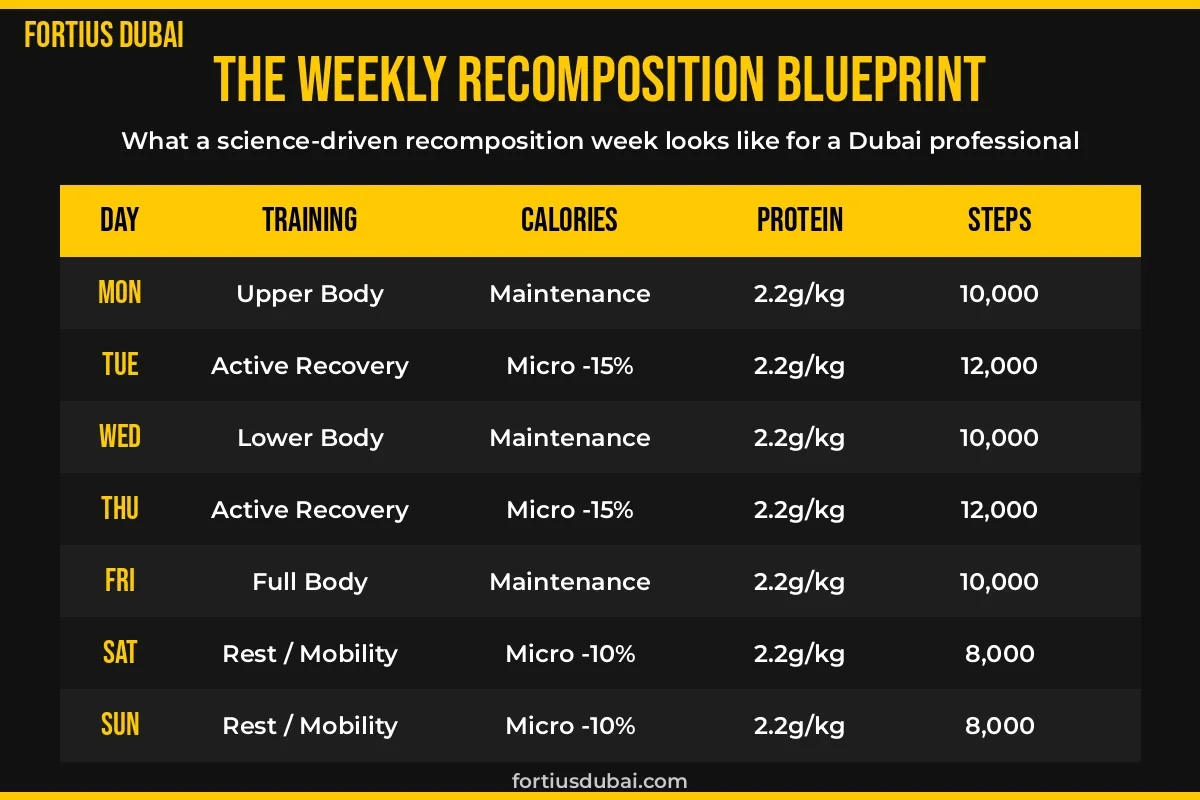
Aggressive caloric restriction is incompatible with muscle building. For body recomposition, calories should be set at maintenance or at a maximum deficit of 10–15% below TDEE. This provides sufficient energy for muscle protein synthesis while forcing the body to use stored fat as its primary fuel source.
Note: Calories are at maintenance on training days to support muscle protein synthesis. The micro-deficit is applied only on rest and recovery days.
Real Results: Cristina's Recomposition Story [From Soft to Athletic in 16 Weeks]
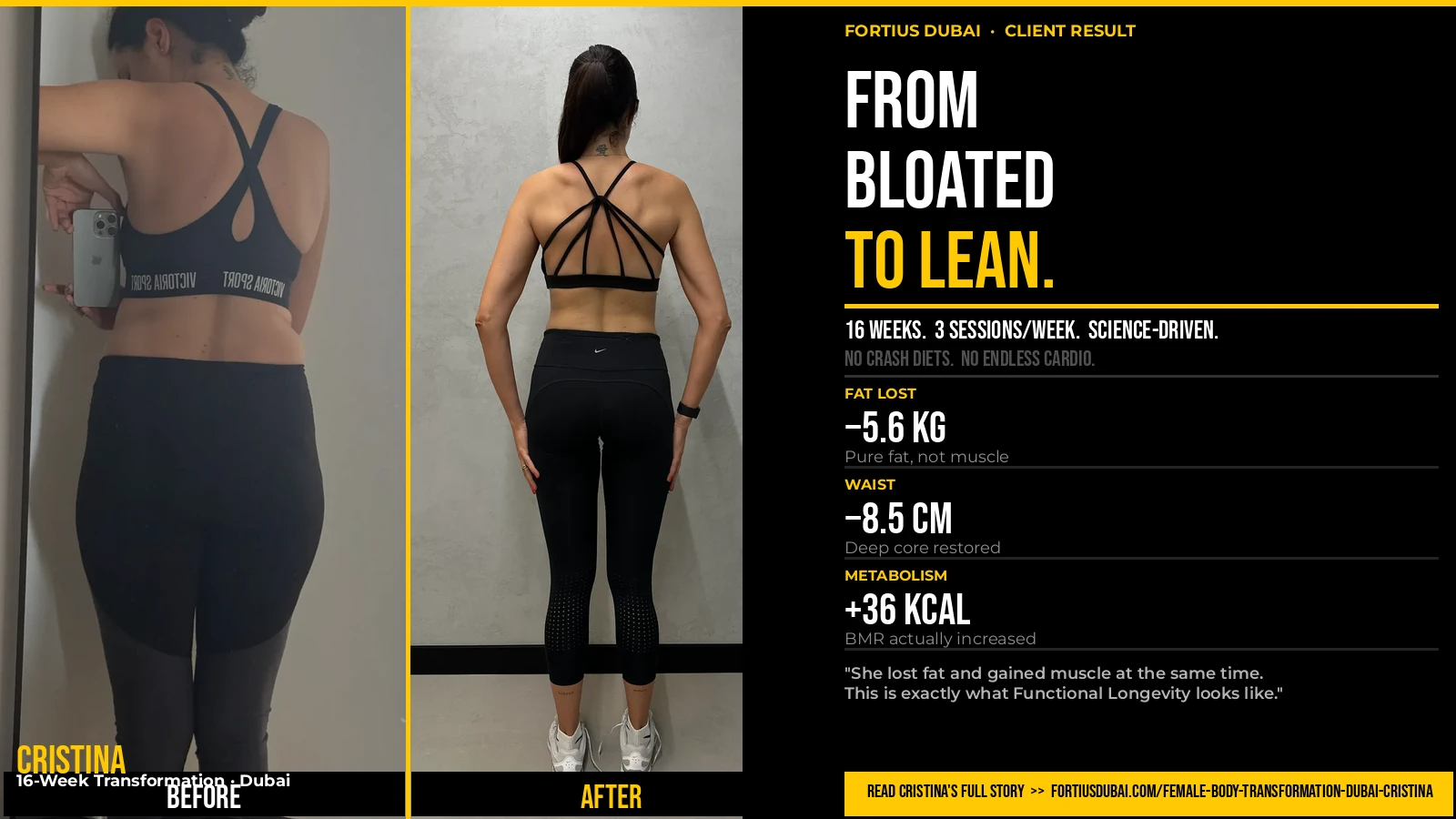
Cristina came to Fortius Dubai with a body composition profile that is typical of the skinny-fat pattern: a normal BMI, but a body fat percentage significantly above the athletic range, with visible softness around the midsection and upper arms despite years of cardio-based exercise and calorie restriction. She had been eating "clean" for years and could not understand why her body was not changing.
Over 16 weeks, following the recomposition protocol outlined above — progressive resistance training four times per week, protein at 2.2g/kg, calories at maintenance on training days and a 12% deficit on rest days — Cristina lost 5.6kg of body fat, reduced her waist circumference by 8.5cm, and increased her lean muscle mass by 3.1kg. Her scale weight dropped by only 2.5kg — but her body composition transformed completely.
The scale was lying to her for years. The protocol told the truth.
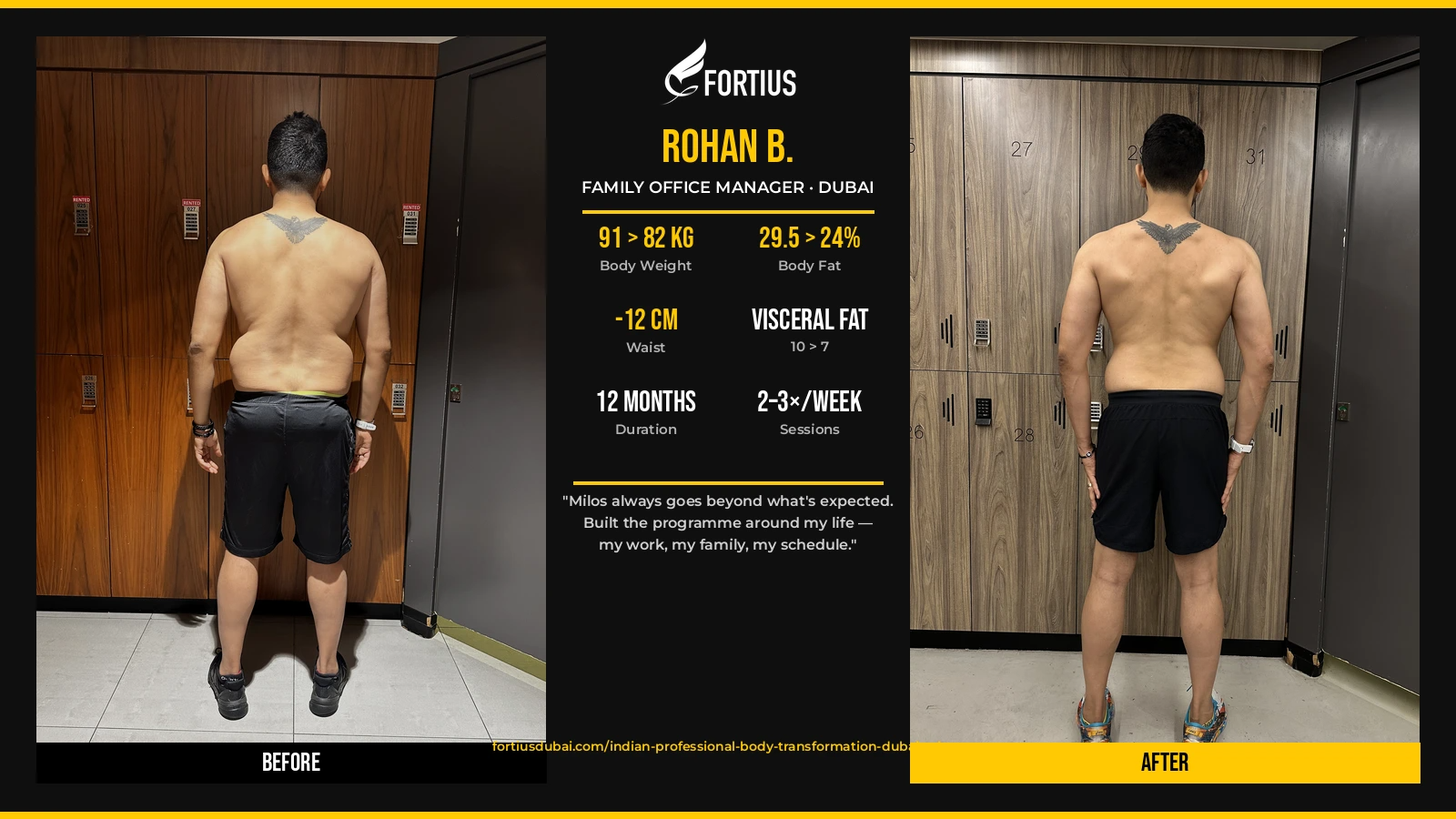
Rohan's story is equally compelling — a Family Office Manager who arrived at 29.5% body fat, rebuilt his physique in 12 months training just 2–3 times per week, and simultaneously rehabilitated a chronic shoulder injury that had limited him for years.
Learn more about our clients' transformation stories: Nick · Charlie · Cristina · Philippe · Rohan · Rusana · Rahman
Frequently Asked Questions About Skinny-Fat and Body Recomposition
Can you be skinny-fat even if you exercise regularly?
Yes. Skinny-fat is specifically associated with cardio-dominant exercise patterns without resistance training. If your exercise routine consists primarily of running, cycling, or group fitness classes without progressive resistance work, you may be burning calories without providing the mechanical tension signal needed to preserve or build muscle. The result is weight maintenance with a worsening body fat percentage over time.
How long does body recomposition take?
Visible recomposition results typically appear within 8–12 weeks of consistent resistance training and adequate protein intake. Significant body composition changes — measurable reductions in body fat percentage combined with increases in lean mass — are typically achieved within 16–24 weeks. The process is slower than pure fat loss dieting, but the results are permanent because you are building the metabolic infrastructure (muscle tissue) that prevents fat regain.
Is body recomposition possible over 40?
Yes, though the hormonal environment changes with age. Testosterone and growth hormone decline progressively after 35, reducing the rate of muscle protein synthesis. However, the mechanical tension signal from resistance training remains effective at any age, and the protein synthesis response to leucine-rich protein sources is preserved well into the fifth and sixth decades of life. The protocol requires more precision and recovery time, but the outcome is achievable.
What is the difference between skinny-fat and just being out of shape?
Being "out of shape" typically refers to reduced cardiovascular fitness or general deconditioning. Skinny-fat is a specific body composition state characterised by a normal or low body weight combined with a high body fat percentage and low lean muscle mass. You can be skinny-fat while being cardiovascularly fit — many long-distance runners present with this profile. The distinction matters because the intervention is different: cardiovascular fitness requires cardio training, while skinny-fat requires resistance training and protein optimisation.
If you are ready to stop guessing and start building the body composition you have been working towards, book a free strategy call with the Fortius Dubai coaching team. We will assess your current body composition, identify the specific hormonal and lifestyle factors driving your skinny-fat pattern, and build a personalised recomposition protocol around your schedule, your goals, and your life in Dubai.
