AI vs. The Human Coach: Why Your Fitness Data Needs a Professional Filter

Introduction
The coaching industry is experiencing a massive shift, with the number of practitioners growing by 54% since 2019. As artificial intelligence becomes a low-cost, scalable alternative to traditional methods, many are asking: Can an AI system replace a human coach? While AI is transforming the fitness industry by powering personalized experiences and predictive insights, the most effective approach for deep transformation is not one or the other—it is a hybrid coaching model.
When choosing between AI-driven platforms and elite human coaching, the best approach depends on whether you prioritize technical data tracking or transformative, long-term behavior change.
The Strength of AI: Structured Data and Scalability
AI coaching tools bring a unique set of strengths to the table, offering immediate support and scalable solutions that democratize access to coaching. By analyzing aggregated data from fitness trackers and apps like the Apple Watch, machine learning algorithms can monitor progress, detect anomalies, and generate actionable insights with higher accuracy than a human could achieve manually.
In a structured, goal-directed coaching process—such as tracking sleep patterns, physical activity, or daily macro targets—AI's ability to track behavior change in real-time gives it a significant edge. It provides a 360-degree view of customer behavior, simplifying complex statistics into real-time feedback that allows users to make quick adjustments to their training program.
The "Accountability Gap": Where AI Falls Short
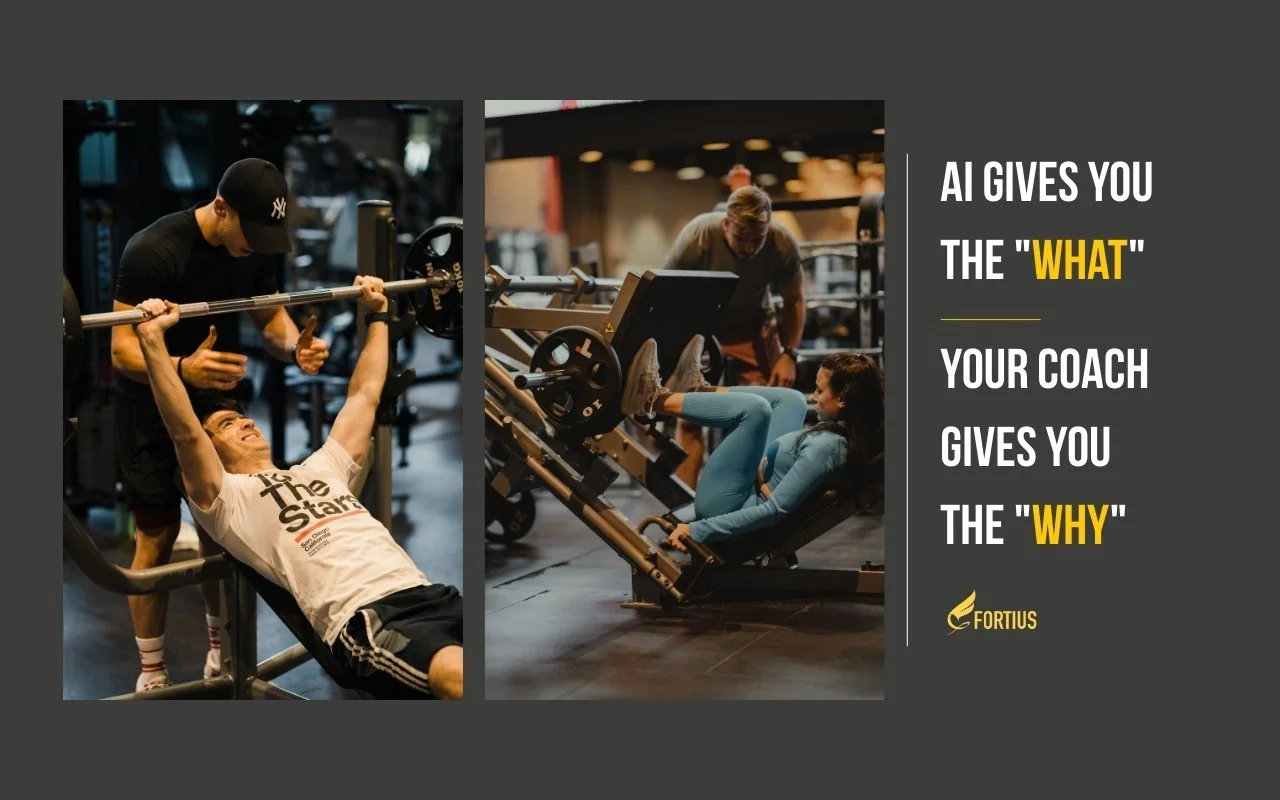
Despite its ability to simulate empathy and process data points, AI lacks subjective experience and cannot share a lived context. This limits its ability to co-create meaning in complex human situations. Research shows that the working alliance—the collaborative relationship between a coach and client—is a critical factor in the effectiveness of coaching.
While clients can build a coaching partnership with an AI, the machine lacks the nuanced reasoning, active listening, and emotional intelligence required for high-stakes decisions or deep self-reflection. Human coaches excel at reading between the lines, sensing unspoken concerns, and validating emotions—elements that are essential for addressing trauma or navigating the cultural nuance of a global city like Dubai.
The Hybrid Approach: The New Gold Standard
The future of coaching is a blended coaching model. This approach uses AI for foundational skills, daily practice, and structured coaching, while reserving human sessions for strategic breakthroughs and transformative growth.
At Fortius Dubai, we have integrated this exact strategy. We use AI to analyze biometric data and movement patterns to provide deeper insights, but we rely on our coaches to foster the human connection and nuanced understanding required for a true life change.
Experience the Future: The Fortius AI Coach
We have developed the Fortius AI Coach as a free tool to democratize access to elite expertise. Trained on over 500+ of Head Coach Milos Tanasic’s personal client responses and our entire science-backed blog library, it provides immediate support rooted in our proven methods. For complex queries, it cross-references the latest meta-analysis and scientific data from Gemini and GPT-4 to ensure you get a verified, expert-level reply.
While AI is ideal for developing specific technical skills and maintaining a goal-directed process, human coaching remains the gold standard for complex, transformative growth. By integrating AI-driven insights with human emotional depth, you achieve the best of both worlds: the efficiency of technology and the relational depth of an expert coach.
AI in Fitness & Coaching: Frequently Asked Questions
Understand the integration of machine learning and elite human expertise with these common insights into the future of the fitness industry.
-
A hybrid approach combines AI for data analysis and data tracking with human coaches for emotional support and complex problem-solving.
-
While AI can analyze biometric data and simulate empathetic responses, it cannot genuinely understand feelings or share the lived experience required to navigate deep emotional challenges.
-
Yes. AI's ability to analyze structured and centralized data from fitness trackers allows it to quantify behavior change and monitor progress with higher frequency than a traditional coach.
-
Unlike generic AI, the Fortius AI Coach is specifically trained on 500+ custom coaching responses and 15 years of fitness expertise to ensure the advice is tailored to our specific transformation blueprints.