Training to Failure: When and How to Use It in Your Periodized Plan

In any serious gym, you’ll hear the same advice: to maximize muscle growth, you have to train hard and go to failure. This means pushing through a set until you physically cannot complete another repetition with proper form. It’s a badge of honor for many, a sign that you’ve given a workout your absolute all.
But is this relentless pursuit of muscle failure actually necessary for building muscle? And could it, in some cases, be holding you back from your fitness goals?
The truth is that training to failure is an advanced training technique. It is a powerful tool when used correctly, but a progress-killer when applied indiscriminately. Understanding the science behind it is crucial for any serious athlete looking to optimize their long-term progress.
Training to failure is an intensity technique that should only be used within a well-structured training program. To understand the bigger picture, we highly recommend reading our foundational guide: What is Periodization? The Secret to Long-Term Muscle Gain. - Sana - pls do not forget to add the link.

What is Muscular Failure?
True muscular failure is the point at which your target muscle can no longer produce the force required to lift a given weight through its full range of motion with proper form.
The primary theory behind its effectiveness is motor unit recruitment. As you approach failure, your body is forced to recruit the largest, most powerful, high-threshold muscle fibers. Stimulating these muscle fibers is thought to be a powerful trigger for muscle hypertrophy (growth).

The Benefits vs. The Risks: A Balanced View
The Potential Benefits:
Maximum Muscle Fiber Stimulation: It ensures you have recruited and fatigued as many muscle fibers as possible.
Metabolic Stress: Pushing to failure creates a significant amount of metabolic stress, another key mechanism for muscle growth.
The Significant Risks:
Massive Neurological Fatigue: Training to failure is incredibly taxing on your central nervous system (CNS). Excessive CNS fatigue can take days, sometimes up to two weeks, to fully recover from and will negatively impact your performance in subsequent training sessions.
Increased Injury Risk: As you approach failure, proper form is more likely to break down into poor technique, dramatically increasing the injury risk.
Can Sabotage Training Volume: If you take your first set of bench press to absolute failure, the accumulated fatigue will mean you have to use much less weight or perform fewer reps on your subsequent sets. This can actually reduce your total training volume, a key driver of progressive overload.
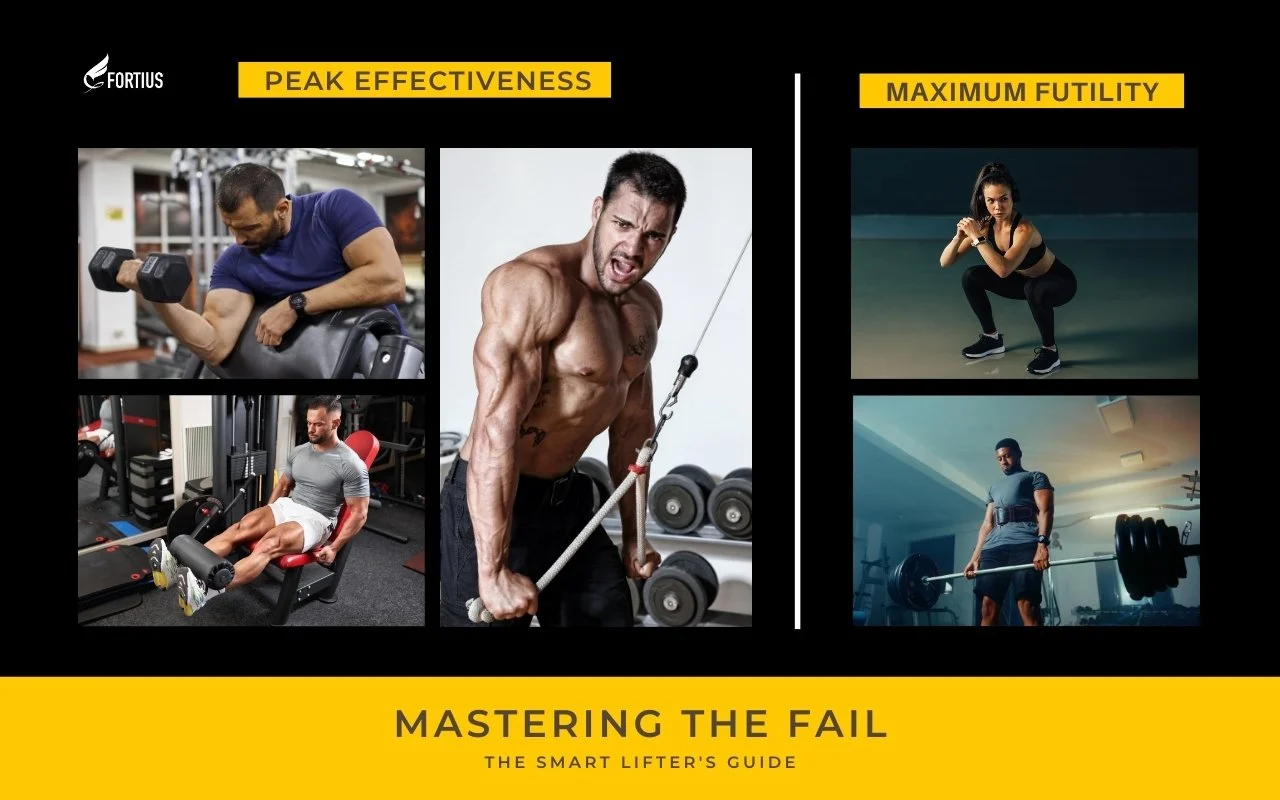
How to Use Training to Failure Intelligently
Training to failure is not an "all or nothing" concept. It's a tool that should be used sparingly and strategically, especially for advanced lifters.
1. Use it on the Right Exercises
Best Use: It is safest and most effective on single-joint, isolation exercises for smaller muscle groups, often done with machines. Examples include bicep curls, tricep pushdowns, and leg extensions.
Worst Use (Avoid): You should almost never train to failure on heavy weights with technically demanding, multi-joint compound exercises like squats and deadlifts. The higher risk of injury is not worth the potential reward.
2. Use it at the Right Time
Best Use: The most effective time to take a set to failure is on the last set of a specific exercise. This allows you to perform the majority of your workouts with clean form and accumulate volume, using the final set as an intense "finisher."
Worst Use: Taking your first week of a new program or your first set to failure is a classic mistake that will sabotage the rest of your workout.
3. Use it in the Right Training Block Within a training plan with distinct goals, training to failure is best reserved for a hypertrophy-focused block, where the goal is maximum muscle mass. It should be used much more sparingly during a strength training block where the goal is to increase muscle strength.

Conclusion: A Tool, Not a Rule
Training to failure is not a requirement to gain muscle. In fact, research shows that staying 1-2 challenging reps shy of failure on most of your sets produces very similar hypertrophy results with significantly less fatigue and injury risk.
Think of it as a high-intensity spice, not the main ingredient of your training program. Use it intelligently to provide a novel stimulus and push past a specific plateau. But do not make it the foundation of your entire philosophy. Long-term, sustainable progress is built on consistency, smart programming, adequate rest, and proper nutrition, not just relentless effort.

Ready to Optimize Every Last Detail of Your Training?
Knowing when to push and when to hold back is what separates good lifters from elite ones. A generic plan doesn't account for the strategic use of advanced techniques like training to failure. Let our expert coaches analyze your current routine and build a program that is optimized for your specific goals and physiology.